Last updated: 2026-10-08

Traditional format

Traditional Marriage Biodata Template | Family Format

Traditional marriage biodata templates often include family background, lineage and horoscope information alongside personal and career details. A modern builder can preserve that familiar structure while letting users remove fields that do not apply.

Quick answer

A traditional Indian biodata commonly combines personal details, parents and siblings, education, occupation, native place and optional community or horoscope fields. Keep the terminology accurate to the family rather than assuming one tradition fits everyone.

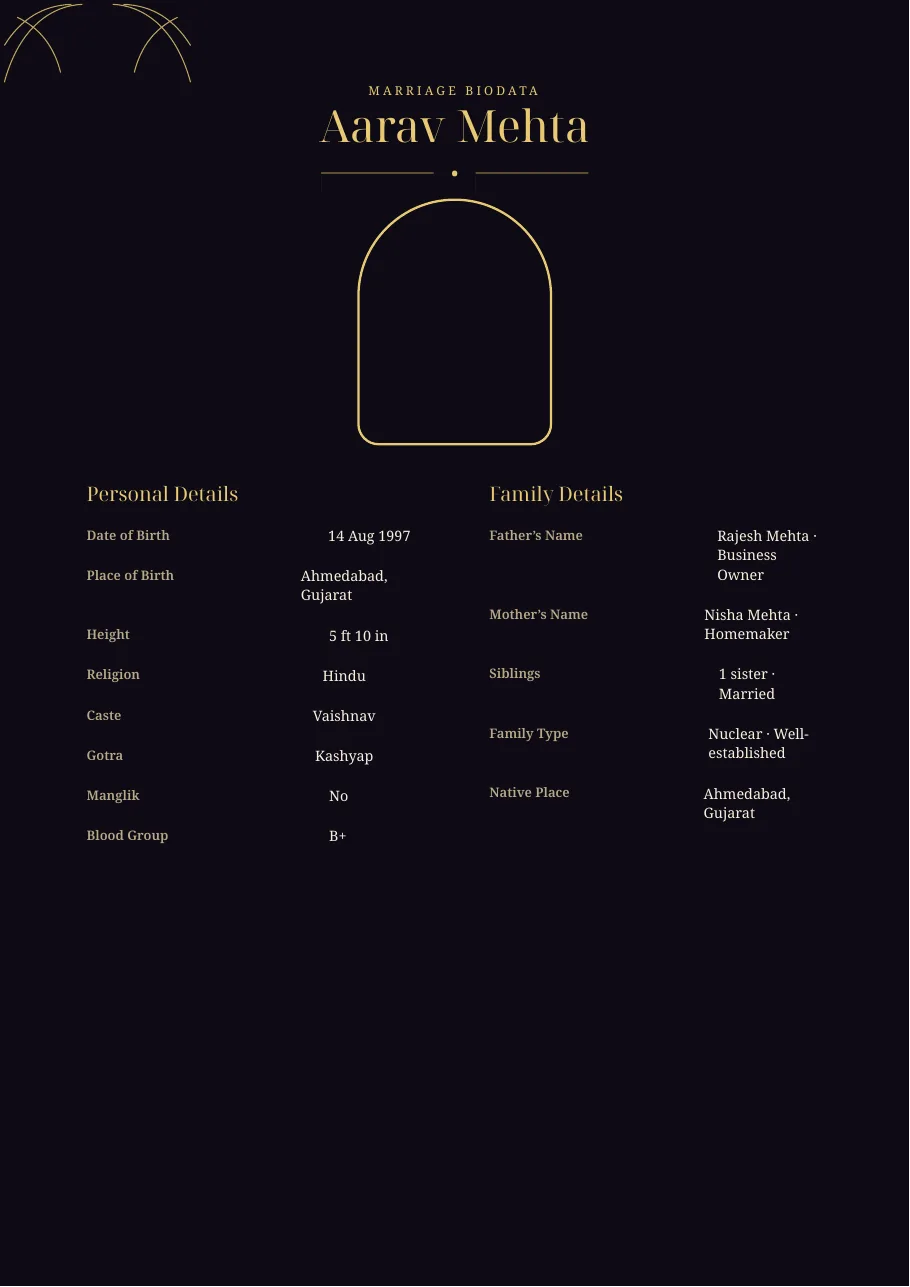
Midnight Gold traditional marriage biodata template preview
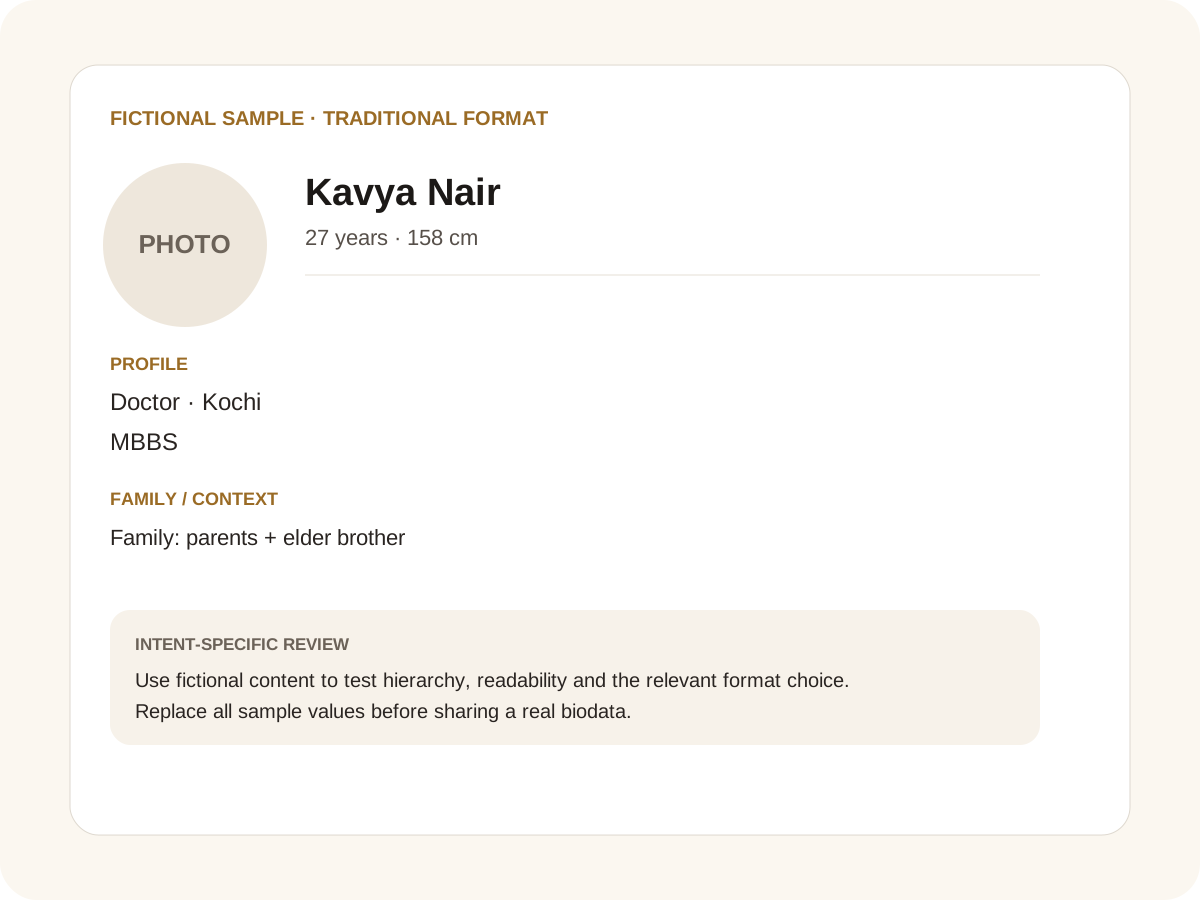
Fictional filled marriage biodata example for traditional format
Fictional sample for layout guidance. Replace every value with your own verified information.

Filled sample

What this example demonstrates

  • ✓ A traditional profile with family-first ordering
  • ✓ A traditional profile with horoscope fields
  • ✓ A classic design with a short About Me

Traditional does not have to mean crowded

Use familiar section names and motifs but keep each field concise. A traditional format can still use whitespace and a clean grid so parents and relatives can scan it quickly.

Religious symbols and community-specific headers should be user-selectable. Hindu/Jain, Muslim, Sikh and Christian families can choose different visual treatments without changing the core information architecture.

Lineage and horoscope fields

Gotra, kuldevi, devak, pravar, rashi, nakshatra and manglik status may be relevant to some households. Add them only when the family actually uses them and verify the values before sharing.

If a separate kundali is prepared, the biodata can carry a short summary instead of reproducing the entire chart.

A traditional profile still needs personality

Education, work, hobbies and expectations help the reader understand the person rather than only the family. A short About Me section can modernise the format without removing its traditional character.

Use a clear profile photo and keep extra photos separate if they are needed.

Common mistakes for this intent

  • • Treating traditional as a fixed checklist
  • • Overusing motifs and borders
  • • Making optional community fields appear mandatory
  • • Forgetting current city and career

Practical examples to compare

  1. 1. A traditional profile with family-first ordering
  2. 2. A traditional profile with horoscope fields
  3. 3. A classic design with a short About Me

How to use a traditional format example

Traditional biodata design often works because its information order feels familiar to families. The fictional example keeps that familiarity while avoiding the assumption that every household follows the same customs. Traditional fields can be optional, and the profile can still include current city, education, work and a personal introduction. The best traditional page is recognisable without becoming rigid: it gives the family the sections they expect while leaving room for the individual to decide what is relevant.

For this intent, the sample facts are deliberately fictional: Kavya Nair is shown as the profile name, while the rest of the values establish a believable context without representing a real person. The example uses 27 years · 158 cm, Doctor · Kochi and MBBS to show how personal, career and education information can sit together. The family line, “Family: parents + elder brother,” demonstrates the amount of context that can be supplied without turning the first page into a family directory. Replace every value with verified information before sharing.

Three situations this format can handle

Three practical ways to use this format are worth testing. First, a traditional profile with family-first ordering. Second, a traditional profile with horoscope fields. Third, a classic design with a short about me. These are different use cases rather than three versions of the same paragraph: one prioritises the information hierarchy, another changes the family context or audience, and the third tests how the design behaves when an optional requirement is introduced. Keeping those choices explicit makes it easier to explain why a particular template or field order was selected.

Review the finished traditional format profile

The most useful review is a content review followed by a rendering review. Check the facts, spelling, dates, relationships and location first. Then inspect the final page at the size at which a parent or prospective match will actually read it. For this page, pay particular attention to traditional format: it should be visible enough to answer the searcher’s question but should not overwhelm the rest of the profile. If a detail does not help a genuine first introduction, remove it rather than shrinking everything else.

A practical checklist

  • ✓ Traditional section hierarchy
  • ✓ Verified lineage fields
  • ✓ Optional horoscope information
  • ✓ Education and career
  • ✓ Short About Me
  • ✓ Clear photo and contact details
Start a free biodata

Related biodata resources

Frequently asked questions

Personal, family, education, career and optional lineage or horoscope details. The exact fields depend on family practice.